

Building the future of 100G Ethernet Data Transmission


100G Ethernet represents a significant advancement in data transmission technology, allowing for data transfer speeds of 100 gigabits per second. This technology is part of a broader family of Ethernet standards, which have continually evolved to meet the rising demand for faster and more efficient network communications. The adoption of 100G Ethernet has become increasingly vital as organizations strive to enhance data center capabilities and meet the needs of bandwidth-intensive applications.
Introduction to 100G Ethernet
At its core, 100G Ethernet enables high-speed networking that supports a variety of applications, including data center interconnects, high-performance computing, and cloud services. By providing such expedited data transfer rates, organizations are positioned to improve their operational efficiency and responsiveness. This technological leap is pivotal in an era where video streaming, online gaming, and real-time data analytics are prevalent, necessitating the requirements for extensive bandwidth.
In terms of performance metrics, the bandwidth capabilities of 100G Ethernet far exceed its predecessors, accommodating the exponential growth of data generated by users and devices. This standard not only improves speed but also enhances data throughput, enabling multiple Gigabit Ethernet connections to coalesce into a singular high-performance pathway. Moreover, 100G Ethernet utilizes advanced encoding schemes and improved optical technologies, mitigating signal degradation and ensuring reliable data transmission across longer distances.
In summary, the introduction of 100G Ethernet represents a critical evolution in network communications. Its rapid data transfer speeds and enhanced reliability make it a crucial component for modern enterprises seeking to maintain a competitive edge in an increasingly digital landscape. Understanding this technology is essential for anyone involved in network infrastructure planning and data management, as it continues to shape the future of data networking.


Applications of 100G Ethernet
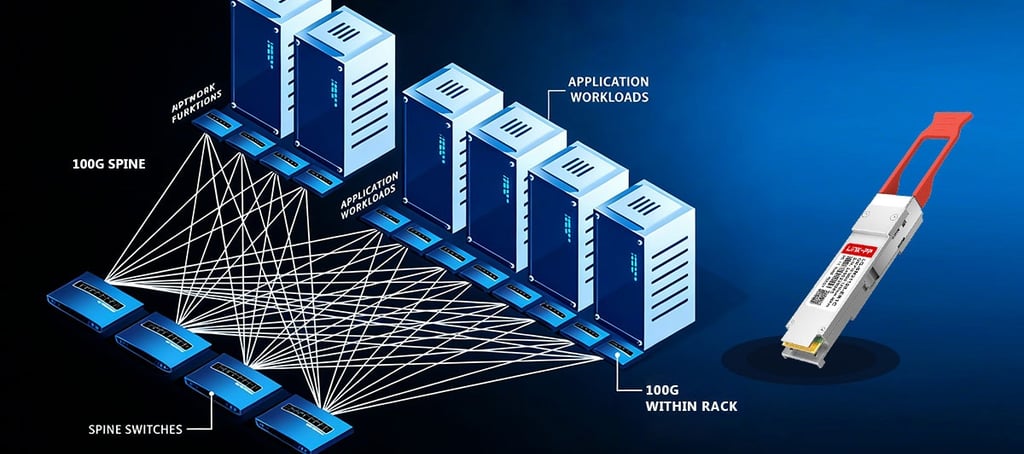
100G Ethernet technology has rapidly gained traction across various sectors due to its ability to deliver high-speed data transmission, essential for managing substantial data volumes efficiently. One prominent application is within data centers, where the surge in cloud computing services necessitates faster connectivity solutions. High bandwidth capabilities of 100G Ethernet facilitate effective data processing and faster transfer rates, allowing for enhanced operational efficiency within these environments.
Moreover, telecommunication companies are integrating 100G Ethernet to support their growing infrastructure demands. As the number of users and connected devices continues to rise, these companies require a reliable technology that can deliver seamless communication services. The implementation of 100G Ethernet in telecom networks also helps in reducing latency, which is critical for real-time applications such as video conferencing and online gaming.
In addition, industries that rely heavily on high-performance computing (HPC) are increasingly adopting 100G Ethernet solutions. These industries, which include research institutions and large enterprises, benefit from the technology’s capacity to handle vast datasets efficiently. For example, simulations, complex computations, and large-scale data analytics tasks require a robust network that can maintain high throughput while ensuring secure data transmission.
Furthermore, financial institutions are leveraging 100G Ethernet to ensure quick and reliable transactions. The financial sector demands ultra-low latency and high-frequency trading capabilities, which are facilitated by this advanced networking technology. This enables financial organizations to execute trades in fractions of a second, thus offering a competitive edge in today’s fast-paced market.
Future of 100G Ethernet and Beyond
The landscape of data transmission continues to evolve rapidly, with 100G Ethernet standing at the forefront of high-speed connectivity technologies. As industries increasingly rely on substantial data transfer capabilities, the demand for bandwidth is projected to surge significantly. This anticipated growth is driven by various factors, including the proliferation of cloud computing, the rise of Internet of Things (IoT) devices, and the expansion of 5G networks. Consequently, the relevance and application of 100G Ethernet are expected to persist and expand well into the future.
As organizations strive to meet these escalating bandwidth demands, innovation in 100G Ethernet technology will likely focus on enhancements in transmission efficiency, cost-effectiveness, and scalability. For instance, advances in optical fiber technology and improvements in modulation techniques are paving the way for more robust and higher-capacity networks. Furthermore, innovations such as wavelength division multiplexing (WDM) could significantly amplify the capabilities of 100G networks, facilitating even higher bandwidth levels without necessitating extensive infrastructure overhauls.
However, the journey toward a 100G-centric future is not without challenges. Industries must navigate issues related to interoperability, network complexity, and the maintenance of legacy systems. Additionally, as technology evolves, so too will cybersecurity risks, necessitating robust defenses to safeguard sensitive data transmitted over high-speed networks.
In summary, the future of 100G Ethernet is poised for growth as intertwined technologies advance and bandwidth demand skyrockets. By addressing the associated challenges and embracing innovation, industries can leverage the full potential of 100G Ethernet, ensuring a seamless high-speed data transmission experience for their stakeholders and end-users alike.
Evolution of 100G Ethernet Standards
The development of 100G Ethernet standards represents a significant milestone in the quest for higher-speed data transmission. The journey began with the IEEE 802.3ba standard, introduced in 2010, which established the foundational specifications for 100 Gigabit Ethernet. The 802.3ba standard defined two primary physical media: the 100GBASE-SR10, utilizing multimode fiber, and the 100GBASE-LR4, employing single-mode fiber. This initial framework enabled data rates that were a substantial leap from the widely adopted 10G Ethernet, thus supporting emerging applications that necessitated faster connectivity.
Following the establishment of the 802.3ba standard, the evolution continued with the 802.3bj amendment introduced in 2013. This amendment primarily focused on improving electrical interfaces for 100G operation over backplanes. The key feature of 802.3bj was its support for 100G over a distance of up to 5 meters using copper cabling, enabling enhanced performance for data center interconnections and within high-density environments. The inclusion of four differential pairs meant greater efficiency in data transmission, making this standard pivotal for short-reach applications.
Further advancements were seen with the release of the 802.3bm standard in 2015, which defined additional optical transport options. This standard extended the range of 100G Ethernet solutions by enabling 100G operation over both longer distances and different types of fiber, thereby catering to a broader array of deployment scenarios. The incorporation of the 100GBASE-ER4 specification, capable of reaching distances of up to 40 kilometers, showcased the growing versatility of 100G Ethernet.
Lastly, the 802.3cd standard, finalized in 2018, further refined the capabilities of 100G Ethernet. It introduced new optical specifications including 100GBASE-ZR and enhanced the support for 400G Ethernet, showcasing an ongoing commitment to future-proofing the technology. Each of these iterations, from 802.3ba through 802.3cd, has played a crucial role in solidifying 100G Ethernet as a vital component in modern data networks, offering enhanced speed, reliability, and versatility.
Lenora Innovation
Empowering Change, Enriching Lives
Copyright © 2026 All rights reserved